
Start with a moment, not the whole room
Instead of deciding that the room has too much furniture, describe one difficult moment: “I turn sideways when I carry the laundry past the chair,” or “I have to move the table before I can open the cupboard.” These observations give you something specific to investigate. A room that looks visually busy may still be easy to use; a sparsely furnished room may have one awkward bottleneck.
Walk through an ordinary activity and note where you stop, detour, reach or move another object. Do not move everything yet. If more than one person uses the room, ask which activity each person finds difficult rather than assuming everyone has the same priority.
Look at four possible constraints
- Furniture footprint
- How much floor area do the objects occupy, and where is that area concentrated? A large item is not automatically the problem; its position may matter more.
- Walking routes
- Trace the route you actually take between the door, seat, cupboard and adjoining room. An empty corner elsewhere does not help if the route you use is blocked.
- Opening and use space
- A cupboard occupies space while closed and needs additional space when opened. Chairs also move when people sit down or stand up. Look at the room in use.
- Competing activities
- A clear route in the morning may become a drying area later. Record when the conflict happens before choosing a permanent change.
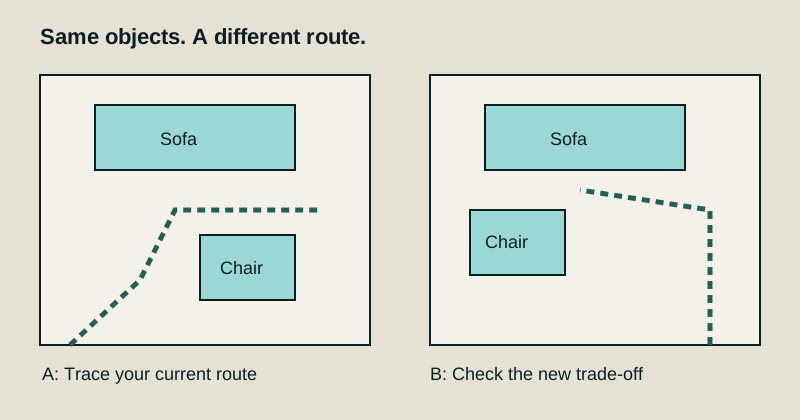
Separate the symptom from a possible explanation
“I cannot carry a basket through here comfortably” is an observation. “The chair is too big” is one possible explanation. The chair's angle, the table's position or a temporary pile might also be involved. Write down more than one plausible explanation if you are unsure.
In the illustrative diagram, the same furniture is present in both arrangements. Moving the chair changes the route, but it may also move the chair farther from the table. The second arrangement is an option to investigate, not a universally better layout.
If the difficulty is concentrated around an entrance, read what to check when furniture interferes with a doorway. If several parts of the room feel difficult at once, use the broader room-layout diagnostic guide.
Furniture fits, but the room still feels cramped
A room can pass a simple fit test and still feel cramped during normal use. Furniture dimensions describe the space an object occupies while stationary. They do not automatically include the route behind it, the space a chair needs when pulled out, the area crossed by an opening door, or the place where someone stands while using storage.
This is why “everything fits” and “the room works comfortably” are different questions. Before deciding that the furniture itself is too large, look at where active-use space overlaps. The problem may be a position, orientation or route conflict rather than the overall amount of furniture.
Pay particular attention to narrow points where several activities overlap. A small conflict beside a doorway or between a chair and table can make the entire room feel constrained even when other parts of the floor remain empty.
Try one reversible change
- Choose the activity that matters most to you.
- Record the current difficulty in one sentence.
- Where practical, change one thing: an item's position, orientation or temporary storage location.
- Repeat the same activity and note whether it became easier.
- Check the trade-off: did you make another seat, opening or route harder to use?
Sketch a change before moving heavy furniture. Keep exits clear, follow the item's handling instructions and get appropriate help rather than testing a risky move. Do not use this exercise to decide structural alterations or compliance with accessibility or fire requirements.
Know when to stop and gather more information
If the change makes little difference, that is useful information. Restore the arrangement if needed and reconsider the explanation. Measure an uncertain gap, observe another time of day or ask another user of the room what happens for them. Some competing needs cannot be resolved through placement alone.
Use the room observation checklist to keep observations and guesses separate. The aim is a clearer next decision—not a promise that every room can be fixed by moving one object.